- The Status No Newsletter
- Posts
- Status No Weekly Newsletter #5

“Prediction is very difficult, especially if it's about the future”
Niels Bohr
Every January lists get made with predictions of what will happen in the coming year. And every year they turn out to be wrong. Predicting the long-term future is a uniquely human fascination. But we’re not very good at it.
We also wonder about our own futures. How much will we change? And how should we prepare for what’s to come? Turns out, this isn’t any easier to answer.
We tend to get it wrong in two ways. We either expect too little change and leave ourselves closed to new possibilities. Or we anticipate too much change, and we get distracted from the present reality we need to navigate.
In this edition of the newsletter I explore the risks in both these errors in our personal and business pursuits. This is a slightly longer piece on one topic, instead of the five short ideas I usually share. I also review research that shows how important intention is when we do things differently. Lastly, I’ve introduced a new section to the newsletter on books I’ve enjoyed reading, and hope you will too.
As always the theme remains the same - to provoke a critical examination of what we accept as “tried and true”.
To get new ideas like this daily follow me on LinkedIn – here.
Think someone else might be interested in receiving these weekly emails? Ask them to sign up using this link:
Predicting future change
Underestimating future change: the end of history illusion
We tend to underestimate the extent of personal change we will experience in the future. Researchers call this the “end of history” illusion. We can easily see that we have undergone significant personal growth and development in the past. But somehow, we think this present version of ourselves - with our current beliefs, preferences, and personality traits - will remain relatively stable in the future.
We think this is the final version of ourselves.
However, research has shown this is incorrect. A 2013 study asked people to predict how much they expected to change in the next decade. As a comparison they also asked people to look back at how much they had changed in the preceding decade. The 30-year-olds predicted less change in the coming 10 years than the 40-year-olds reported experiencing in the previous decade. Across all age groups people reported more change had occurred than their younger counterparts predicted.
Believing most personal change is behind us can make us complacent and less inclined to explore new interests and challenge ourselves.
It can also impact our behaviours in other areas:
• Unrealistic expectations of others: since the significant people in our lives are likely to change too our illusion of stability can place a strain on evolving relationships.
• Adapting to major life transitions: career changes, parenthood, retirement all require a flexible approach to avoid stress, confusion and a sense of loss.
• Compromised decision making: when we make long-term decisions based on our current view of our lives we risk setting ourselves up for a misalignment with future goals and needs.
Predicting the future is difficult, if not impossible. While we know we’ll change, we don’t yet know the direction or magnitude of change we’ll experience in future. But placing all bets on things staying the same is a losing proposition. It’s a reminder to allow room for our future selves to be different than our present selves.
Overestimating future change: the best business for your size
Much of the same can be said for underestimating change in a growing business. We are just as likely to view the present version of our businesses as stable and future-proof because most of the changes are behind us. Here too, we shouldn’t underestimate the change that lies ahead.
But we also shouldn’t overestimate it.
I’ve observed a tendency in growth-minded businesses to prepare for the next level as if it is imminent. If we plan to be a big business one day, surely we need to hire senior talent now, grow our corporate services, invest in infrastructure that will last, add layers of quality controls and have more formal decision-making structures. All things we’ll need when we get there.
I think this is wrong.
I believe you should aim to be the best business for your current size. When starting out, small teams do well when they have more flexibility and less red tape. Decisions can be made faster. Budgets don’t need to be burdened with investing for future versions of a business that may change. Strategies can be more agile based on client needs. The direct contact with founders doesn’t need to be intermediated with a management layer. And the limited resources are best spent being responsive to the needs of the business as it is, and not what it could be.
As you grow, the new level (if these can be defined so neatly) requires a different mindset from what came before and what will come next. But devoting time on a future that is yet to arrive is a distraction from what makes you great now.
The point is that you earn the right to unlock the next level by being the best at your current level.
Like any complex issue there is nuance here. Some early decisions are durable and should be considered with care. Bad hires, weak infrastructure and controls will catch up with you. Without forward planning you’ll be caught off-guard when the next level arrives, as suddenly as it often does. But spending most effort on what matters now enables you to be the best in future.
Different by design
A 2013 study examined how people react to nonconforming behaviours like wearing gym clothes in a luxury boutique or wearing red sneakers in a professional setting.
The result? When the nonconformity seemed intentional and deliberate it boosts perceptions of status and competence. When it appeared accidental, it backfires.
I think this same effect applies to other acts of nonconformity.
When we started our research agency in 2008 the typical pitch proposals were bloated, 50-100 slide monsters. Clients would skim, at best, 10% of them and it took a week to prepare.
This was a massive waste of time for everyone involved.
So we stripped it down. A 5-10 slide template covering only the essential 10%.
It worked. We spent less time creating proposals, clients got answers quicker and win rates went up.
But here's the key: We made it clear our mini-proposals were intentional. We showed respect for everyone's time and set expectations accordingly. If we had simply sent an unconventionally short proposal without this context it would seem lazy and out of touch.
Be different, but make sure they know it's on purpose.
Worth reading
Decision Time: How to make the choices your life depends on (Laurence Alison & Neil Shortland, 2001)
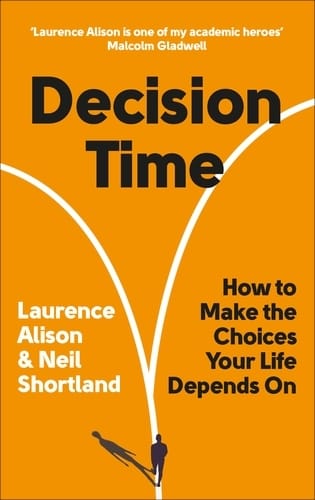 | A book about how to apply the decision-making tools from research on high-stakes military and security situations to important choices in your personal life. |
One idea the book reinforced for me is that not making a decision or avoiding taking action is a choice to remain with the status quo. For better or worse.
”Many people assume that the biggest ‘mistake’ you can make when making a decision is to choose the ‘wrong’ thing. But our experience and research has led us to believe something very different: the biggest ‘mistake’ you can make is to do nothing”.
As always, I appreciate your feedback. Some reader comments have already sparked ideas to be used in the newsletter and the book. I look forward to your responses to this edition - just reply to this email.
Thanks for reading.
Henk
Reply